About the programme
Training takes place in France, within the AAVA club’s Declared Training Organisation (DTO) in Vinon-sur-Verdon. The programme is suitable both for complete beginners and for people with a little flying experience. We work through each stage, from the first lessons and your first solo flight to cross-country training and the skill test for the Sailplane Pilot Licence (SPL).
I teach in Russian, Ukrainian, English or French. You can choose the language you are most comfortable with.
In this section
My approach
Not just knowing how to do it, but understanding why.
Flying starts on the ground. Preparation, discipline and consistent adherence to rules and procedures are just as important as handling skills. A knowledge of aerodynamics and meteorology helps you understand what is happening and make informed decisions, rather than simply operate the controls mechanically.
Safety is the main priority in SPL training. Initial training cannot prepare you for every type of demanding long-distance flight. My role is to help you develop the basic skills and a sound foundation so that, after gaining your licence, you can continue to progress independently at your own pace, according to your interests and goals. Glider pilots keep learning throughout their lives.
Flying should remain an enjoyable pastime, not a test of courage.
Preparing before you arrive
When we arrange your first visit, I send you recommendations, links to my Telegram channel "Планерная школа" (Gliding School), instructional videos on my YouTube channel and suggested reading. I recommend watching at least the first three videos in the training series before you arrive. You are welcome to watch the others as well, but this is optional: we will return to these materials during training.
Bring clothing suitable for the season and a hat, preferably a bucket hat. Sunglasses are optional. You do not need to buy any specialist clothing or equipment.
For your initial registration at the club, your passport is sufficient. There are no special documents to prepare in advance.
An aviation medical examination can be arranged at the club: a doctor visits at an agreed date and time. If you have been prescribed glasses to correct your vision, you must bring them to the examination, even if you do not usually wear them.
Your first day in Vinon
We meet at an agreed time, usually in the morning, around 09:00–10:00. After introductions, we visit the club office to arrange membership, the necessary insurance and other registration formalities.
I then give you a short tour of the airfield, showing you where things are and what you will need for training and everyday life at the club. We discuss any flying experience you may have and establish how familiar you already are with aviation theory. This helps me take your preparation into account and decide where to begin.
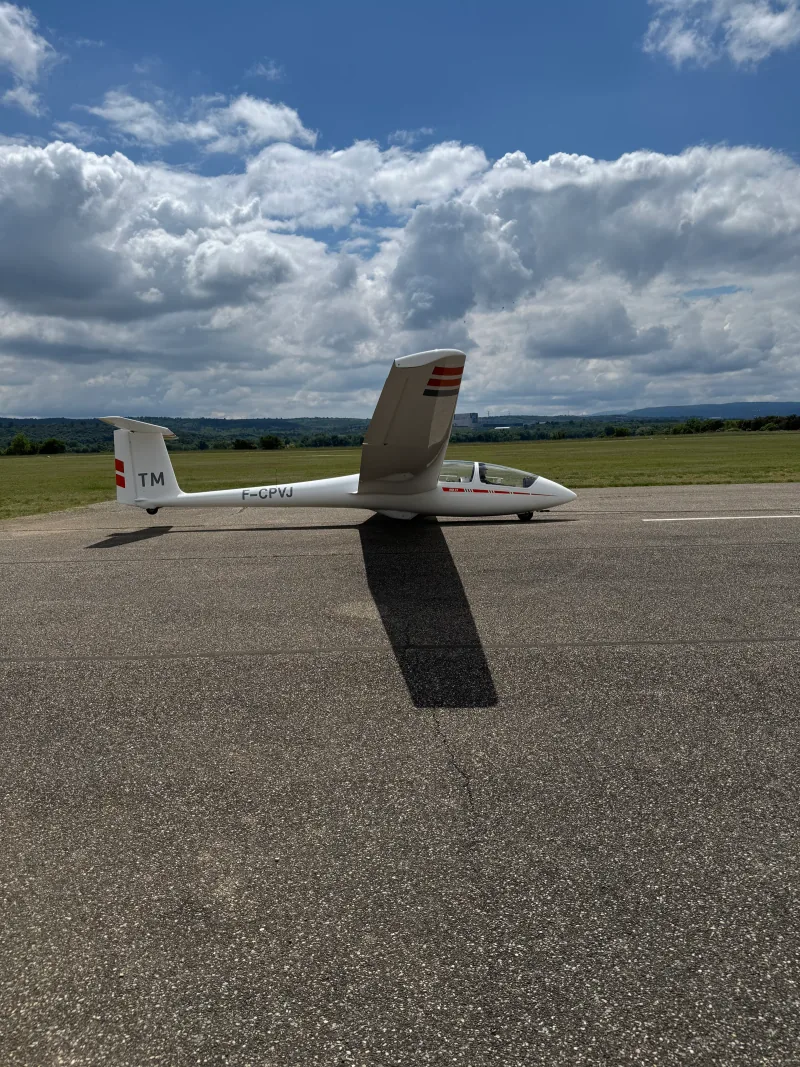
Next, we look over the training glider and prepare it for flight. I explain its layout, the names of the main components, the required procedures and how we will work together. The first flight is usually a chance to become familiar with gliding, with some initial instruction.
Afterwards, we review the flight, discuss your impressions and agree on our next meeting and what you should prepare beforehand.
Your first training visit to Vinon
The initial phase of SPL training, from your first flights with an instructor to your first solo flight, takes place in an ASK 21 built by Alexander Schleicher. We cover glider handling, take-off and aerotowing, approach and landing. This stage involves many short flights, as the basic skills need repetition and practice.
If you have little or no experience, I recommend two calendar weeks for your first visit. In my experience, this is usually enough to reach a first solo flight in the local area around the airfield. It is not a guaranteed timescale: you fly solo when you are ready, taking the flying conditions into account.
It is best to avoid a long break during this initial stage. The skills are still developing, and after several months without flying, some training time will be needed to rebuild them. If you cannot set aside two consecutive weeks, you can come for one week. A shorter visit is better seen primarily as an introduction to gliding and an opportunity to decide whether you would like to continue learning.
If you fly solo before the end of your stay, training continues: we move on to the cross-country phase. Some elements of this phase can also be practised in winter, including January and February.
Cross-country training
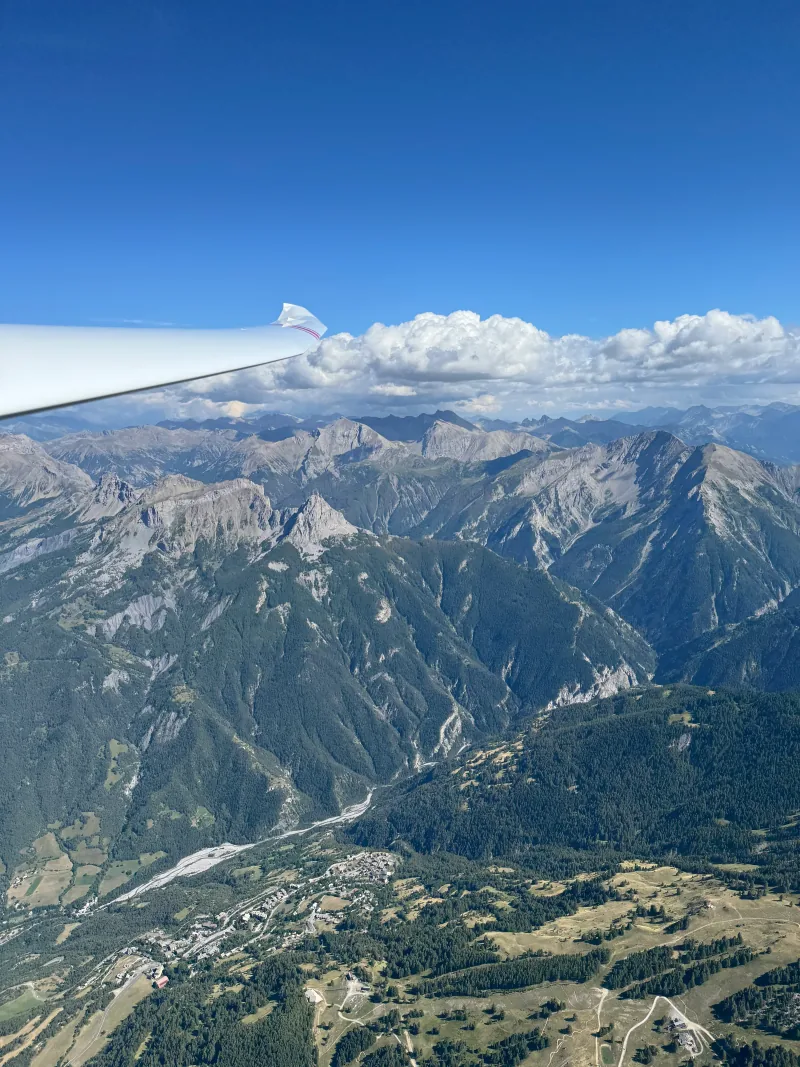
In the second phase of the programme, we move on to a Duo Discus built by Schempp-Hirth and learn cross-country flying: finding lift, climbing in it and choosing a strategy suited to the weather.
We focus particularly on timely decisions and keeping a safe landing option available if the lift disappears or the weather deteriorates. The first cross-country flights remain relatively close to the base, within reach of neighbouring airfields. If necessary, we can land at one of them rather than having to return to the departure airfield.
Each student usually makes one longer flight per day, lasting around 2–3 hours. There are fewer take-offs and aerotows than in the initial phase.
On average, the cross-country phase takes 2–3 calendar weeks, with a normal rhythm of around six flying days per week. This is a guide, not a fixed duration for everyone. You do not need to complete the whole phase in one stay: training can continue over separate visits. I recommend allowing at least a week for each visit, as even one or two non-flying days can significantly reduce the training time available on a short trip.
A training day and the weekly rhythm
The daily schedule depends on the stage of training. In the initial phase, we often start flying at 08:00 to use the calmer morning conditions for take-off and landing practice. These conditions are better suited to learning the basic skills. In the cross-country phase, flying usually begins after midday.
In both cases, we attend the club's general pre-flight briefing at 10:00. It covers the day's weather, any particular considerations for flying that day and advice for pilots.
Before flying, we prepare the glider and discuss the day's tasks and the theory behind them. In the air, we practise what we have planned. After landing, we review the actions, decisions and mistakes made during the flight.
At the end of the day, we discuss the next steps. I usually suggest some preparation for the next session: something to read, watch or study.
During settled good weather, we normally fly six days a week and take Sunday off. If a non-flying day is forecast, we may move the rest day to that day and fly on Sunday instead. This is an option, not a requirement.
Theoretical knowledge training
You can prepare for the SPL theoretical knowledge examination in French or English using interactive learning systems and study materials. You can start before your first visit. Once we have agreed on your training, we discuss suitable materials and how to organise your preparation individually.
The examination can be taken in French at the club. Taking it in English in Luxembourg is also an option, while completing your flight training in France.
The skill test and obtaining your licence
We move on to the skill test once the training programme is complete and the requirements have been met. Simply reaching the minimum flight time is not enough: the instructor assesses whether you are ready. At this stage, you need a valid pass in the SPL theoretical knowledge examination and a valid medical certificate.
The club prepares the necessary paperwork and coordinates the test with the French civil aviation authority. An examiner from the club, other than your instructor, conducts the test, providing an independent assessment of your preparation. You can communicate with the examiner in French or English during the skill test.
The test has four separately assessed sections: pre-flight preparation; take-off and aerotowing; general airwork and specified exercises; approach and landing. The ground section assesses your use of documentation, weather assessment and decision-making as pilot-in-command, rather than repeating the theoretical knowledge examination. In the format described here, the flying part includes a cross-country flight followed by exercises agreed in advance. Each section is assessed as pass or fail, without a numerical score; all four sections must be passed to pass the test. A debriefing normally follows.
We complete the necessary paperwork on the day you pass. You receive a temporary certificate, known in French as an attestation provisoire, allowing you to exercise the pilot privileges specified in it for up to eight weeks while your SPL is being issued. Once issued, the licence is sent by post to the club or to your address.
When to come
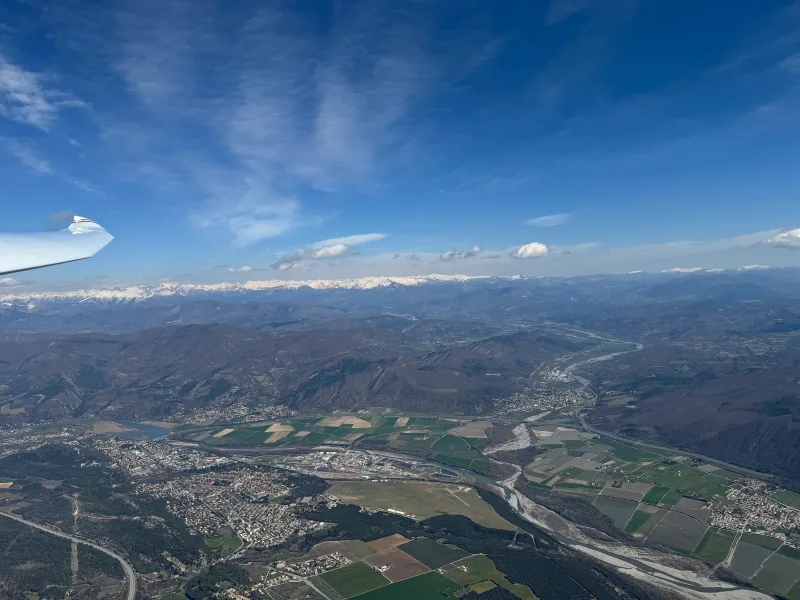
I normally teach in Vinon from late January until around 25 October. The club operates almost all year, including weekends and public holidays, with a short break over Christmas and New Year. From early November to mid-January, I offer gliding in Namibia.
We arrange training dates individually, with no mandatory minimum booking lead time. The earlier you get in touch, the better your chances of securing your preferred dates. I usually work with one or two students during the same period, each with their own training tasks appropriate to their stage of progress.
Getting here
I recommend flying into Marseille Provence Airport (MRS). Nice Airport (NCE) is an alternative, with a longer onward journey. You can hire a car at the airport and drive to your accommodation or the club. AAVA address and directions.
You can reach Vinon itself by bus from Marseille Airport with a change in Marseille or Aix-en-Provence. When planning your trip, check the airport bus services and ZOU timetables to find a suitable connection.
Without a car, you can also take a bus from Marseille Airport to Manosque. Check the current timetable when planning your journey. We discuss any possible pick-up in Manosque in advance: I am usually flying during the day and cannot always collect you or arrange for someone else to do so.
Another option is a taxi or a ride booked through Uber or Bolt. Check the price and availability when booking.
Accommodation
Vinon and the surrounding area offer accommodation to suit different budgets and comfort preferences.
For a short stay, the club rooms are among the more affordable options. They are small and simply furnished, with a bed, desk and chair; showers and toilets are in a shared facilities block. There is also one more comfortable room with its own bathroom.
In the warmer months, you can rent a caravan at the club campsite or bring your own tent, caravan or motorhome. Electricity, showers and toilets are available. I arrange club accommodation through the club office.
There are two small Provençal-style hotels about 500 metres from the club. I also help with bookings at La Clape, a comfortable guesthouse within walking distance of the airfield.
Having a car gives you a wider choice of hotels and apartments in Vinon, Gréoux-les-Bains and Manosque. You book these yourself through Airbnb, Booking.com or directly. For a stay of two weeks or more, it is worth comparing options: renting an apartment may cost less than paying the nightly rate for a club room.
Meals
The Clubhouse has a shared kitchen with a cooker, kitchenware and fridges, where club members can prepare their own meals. There is a Carrefour supermarket around 2.5 kilometres away, as well as other food shops nearby.
Le Planeur restaurant is on the edge of the airfield, about 300 metres from the Clubhouse. Vinon, Gréoux-les-Bains and Manosque also have restaurants offering a range of cuisines and prices.
What your budget covers
- Instruction: ground and flight lessons, theoretical explanations, preparation for the test and flight debriefings.
- Club and federation fees: club membership, FFVP membership (the federation licence) and insurance, and daily flying fees.
- Flying: glider hire charged according to actual flight time, and aerotows charged according to the tow aircraft's actual operating time. At the initial stage, the frequent short flights mean aerotows account for a significant share of the budget.
- Study materials and documentation: the online theory course, aviation medical examination, pilot logbook, map and landing-site guide; the SPL issue fee is also payable when training is completed.
Annual club membership, annual FFVP membership and annual insurance do not need to be paid again if you return within the same calendar year.
My instruction is paid for separately, and you pay the club's charges directly to the club. Accommodation, meals, travel and local transport need to be budgeted for separately from training.
Before we finalise your trip, I will help you estimate the budget for your first visit and further training, taking your experience into account. The final cost depends on the actual number of training days, flight time and aerotows.
Discuss starting your training
Let me know whether you would like to start from scratch or already have some flying experience, and which dates you are considering. We can discuss a suitable first visit, how to prepare for it and an initial budget.
 Message me on WhatsApp+33 6 52 90 81 75